

Visiting Temples and Shrines in Japan as a Muslim
Last checked: 5 Nov 2026
Visiting temples and shrines in Japan as a Muslim is easy and very common. You can walk the grounds, admire the buildings and learn the history as an observer, and no one expects you to bow, pray, make an offering, buy a charm or wash at the purification basin. This guide explains what you are looking at, the simple rules that matter (shoes, photos, dress), and how to plan prayer around the most famous historic sites.
Shinto shrines and Buddhist temples: what is the difference?
Japan has two main traditional religions, and most historic sites belong to one of them. Many Japanese people visit both without seeing any conflict, so the two often appear side by side.
Shinto shrines (jinja)
A Shinto shrine is a place where *kami*, the deities or spirits of Shinto, are enshrined. You can recognise a shrine by its torii gate, which marks the boundary between everyday space and the shrine grounds. Shrine names often end in *-jinja*, *-jingu*, *-gu* or *-taisha*, such as Meiji Jingu in Tokyo or Kasuga Taisha in Nara.
Buddhist temples (tera)
A Buddhist temple houses statues of the Buddha and of other Buddhist figures, and is often linked to a monastery or a family graveyard. Temples usually have a large sanmon gate, sometimes guarded by two fierce wooden statues. Their names often end in *-ji*, *-dera* or *-in*, such as Todai-ji, Kiyomizu-dera or Kotoku-in.


Castles and historic villages
Castles and old villages are not religious places at all. They are history sites, often run as museums, and the main things to know are about shoes, steep stairs and walking distances. They are a good choice if you want a day of culture with no worship around you.
Visiting as an observer: what you can skip
The most common question Muslim travellers ask is whether they must join in. The answer is no. Shrines and temples welcome people of all faiths as visitors, and Meiji Jingu, for example, states that visitors of any religion may enter its grounds.
Many Muslims choose to visit as respectful observers and simply leave out the acts of worship. Here is what you will see, and what you can quietly skip.
- The purification basin (temizuya or chozuya). Near the entrance there is a stone basin with ladles. Japanese worshippers rinse their hands and mouth here before praying. It is a Shinto or Buddhist rite, so you can walk past it. It is also not a place for wudu; use a prayer room or your hotel instead.
- Praying at the main hall. At a shrine, worshippers toss a coin into the offering box, ring a bell, bow twice, clap twice, pray and bow once more. At a temple they pray silently without clapping. You do not need to do any of this. Standing a little to the side and watching is perfectly fine.
- Incense. At many temples people buy a stick of incense, place it in a large burner and wave the smoke over their bodies, a custom believed to bring good health. You can look without joining.
- Bowing. Some visitors bow at the gate. A bow is also an everyday greeting in Japan, but it is never required of visitors at a shrine or temple. Walking through calmly and quietly is respectful enough.
- Charms and fortunes. Shrines and temples sell *omamori* (small charms) and *omikuji* (paper fortunes). These are religious items, and many Muslims choose not to buy them. If you want a souvenir, local crafts, sweets or a book about the site are good alternatives.
- Stamp books (goshuin). The calligraphy stamps that many visitors collect are given at the temple or shrine office as a record of worship. You can skip these too.
A useful way to think about it: you are visiting a place that is sacred to other people, much like a non-Muslim tourist visiting a historic mosque. You show respect through quiet behaviour and care, not by taking part.
Basic etiquette: shoes, photos, dress and behaviour
A few simple habits will make you a welcome guest at any temple, shrine or castle.
Shoes
Many temple halls and almost all castle keeps ask you to take off your shoes. There are usually shoe shelves, lockers or plastic bags at the entrance. At Sanjusangen-do in Kyoto you remove your shoes before the main hall, and at Himeji Castle outdoor shoes are not allowed inside the buildings at all.
- Wear clean socks without holes; floors are often cold wooden boards.
- Shoes that slip on and off easily save time, especially if you also need to do wudu later.
- Keep track of your shoes. Nijo Castle reminds visitors to be careful not to take the wrong pair.
Photos
Photos are welcome in most outdoor areas, but rules change from place to place, so look for signs.
- Do not take photos while people are praying, during ceremonies, or right in front of the offering box.
- Meiji Jingu does not allow photos or videos in front of its main sanctuary, where people pray.
- Nijo Castle does not allow any photos or videos inside the Ninomaru-goten Palace.
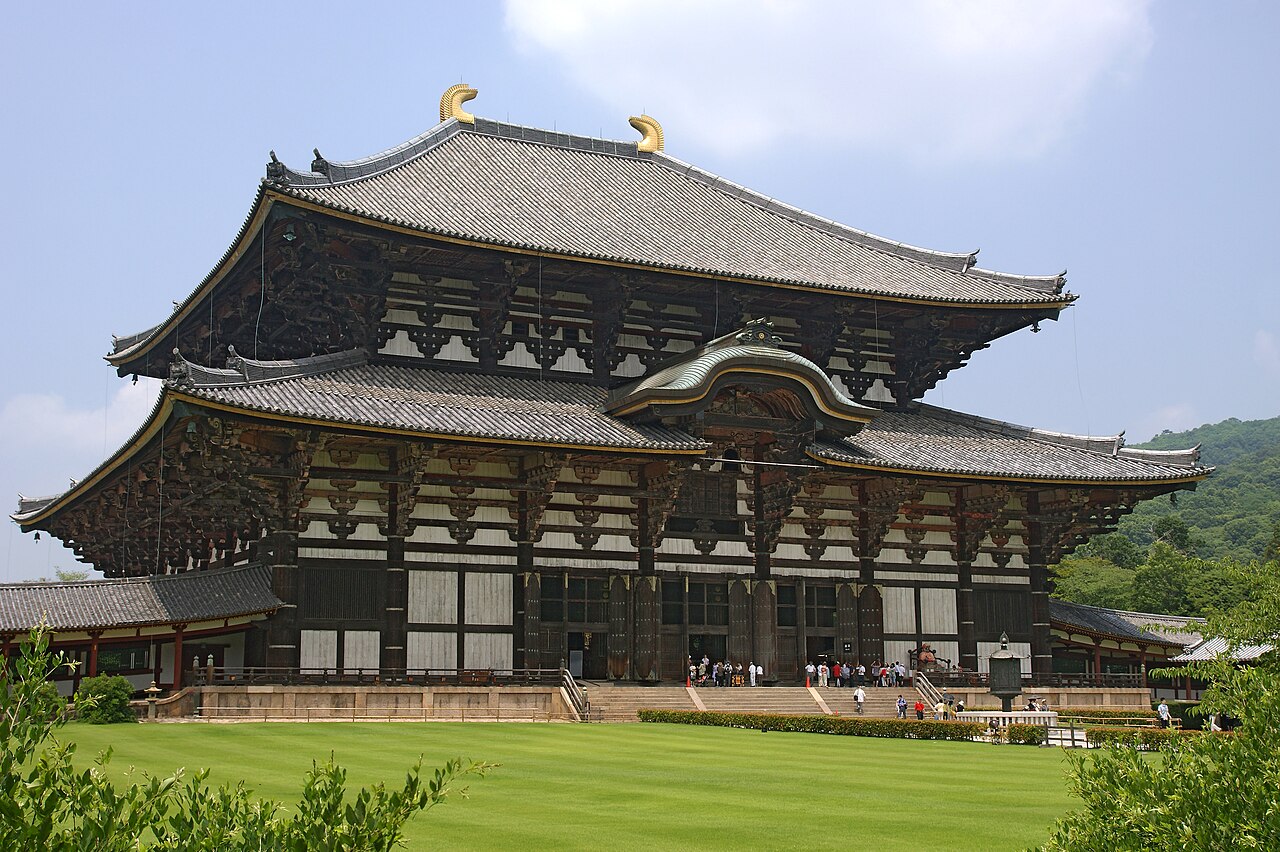
- At Todai-ji, personal photos are allowed inside the Great Buddha Hall, but not tripods, flash or group photos.
- Drones are banned at many sites, including Kiyomizu-dera and Nijo Castle.
Dress
There is no formal dress code, but modest clothes are appreciated at sacred places. The Aichi Prefecture tourism guide notes that revealing outfits or shorts may make some people uncomfortable. This fits easily with Muslim dress: long sleeves, long skirts or trousers, and a hijab are all completely normal. You are never asked to remove a hijab or other religious head covering.
Behaviour
- Walk at the side of the main approach. The centre of a shrine path is traditionally kept for the deities, so many Japanese people walk slightly to the left or right.
- Step over thresholds, not on them, when entering temple buildings.
- Do not touch pillars, walls or statues.
- Keep your voice low, especially inside halls.
- Eat only where it is allowed. At the Great Buddha of Kamakura, food and drink are not allowed on the grounds at all. At Kiyomizu-dera and Nijo Castle, eating is limited to cafes or rest areas.
- Take your rubbish with you. Many sites have few or no bins.
Visiting temples and shrines in Japan as a Muslim: planning prayer
Temples and shrines do not have prayer rooms of their own, so it helps to plan a little. Large sites can take hours to see: Todai-ji says that its full suggested route takes about four hours even at a quick pace.
- Check the day's times before you leave on our area pages, for example Kyoto prayer times or Nara prayer times.
- Look up the nearest prayer room for each area, such as Kyoto prayer rooms and Nara prayer rooms. Several are at tourist information centres near the station that takes you to the sights.
- Pray before you set off, then plan the next prayer near a station or information centre on your route.
- Carry a light prayer mat and a compass app. Our guide on how to find a place to pray in Japan explains how to ask staff for a quiet space.
Food is the other planning point. Snacks sold at temple stalls are rarely labelled in English, so read our guide to food labels in Japan before you go.
Highlights: the great historic sites and how to visit them
The sites below are among the most visited in Japan. Most of them are part of a UNESCO World Heritage property. Opening hours and fees change, so check each official site before you go.
Nikko Toshogu (Tochigi)
Nikko Toshogu is a richly decorated shrine complex in the mountains north of Tokyo. Tokugawa Ieyasu, the first Tokugawa shogun, was enshrined here after his death in 1616. Its Yomeimon Gate has more than 500 carvings in bright colours and gold. Look for the famous carvings of the three monkeys ("see no evil, hear no evil, speak no evil") and the sleeping cat.
To reach the inner shrine (Okusha) you climb 207 stone steps, so allow extra time and energy. Trains from Asakusa to Tobu Nikko Station take about 110 minutes, and a bus to the shrine area takes about seven minutes. The Nikko City Tourism Association notes that the shrine's ticket counter takes cash only.
For prayer, the JNTO Muslim guide lists a prayer room at Tobu Nikko Station, open year-round from 8:20 to 16:00. Ask at the tourist centre on the first floor; the station is busy in the morning, so giving notice in advance is a good idea.

Tobu Nikko Station Prayer Room
- Ask at reception first
Shirakawa-go and Gokayama (Gifu and Toyama)
These mountain villages are famous for their *gassho-zukuri* farmhouses with steep thatched roofs. They were listed as a World Heritage site in 1995. There is no worship to think about here, but there is an important point of manners: people still live in these houses.
- Do not enter private homes or gardens, and do not look into windows.
- There are no rubbish bins in Ogimachi village, so take everything with you, and use only the public toilets.
- The busiest seasons are May, August, September and October. Arrive early if you want quieter streets.
Ainokura in Gokayama, on the Toyama side, is part of the same World Heritage site, and the same manners apply there.
 UNESCO World HeritageShirakawa-go (Ogimachi Village)Gifu→
 UNESCO World HeritageGokayama Ainokura Gassho-style VillageToyama→
Kyoto: Kiyomizu-dera, Kinkaku-ji, Sanjusangen-do and Nijo Castle
Kyoto's temples, shrines and castle are part of the World Heritage site "Historic Monuments of Ancient Kyoto". You could spend a week here, so choose a few and leave time for prayer.
UNESCO World HeritageKiyomizu-dera TempleKyoto→
UNESCO World HeritageKinkaku-ji (Golden Pavilion)Kyoto→
UNESCO World HeritageNijo CastleKyoto→
Kiyomizu-dera is a Buddhist temple on the slopes of Mt. Otowa. Its Main Hall, rebuilt in 1633, stands on a steep cliff and is famous for its wooden stage. Below it is the Otowa Waterfall, where visitors catch water from three streams and pray for their wishes; you can simply watch. The temple opens at 6:00 and closing times change with the season, so check its site. It has barrier-free routes, and it asks visitors not to eat while walking. It is about a 20-minute walk from Kiyomizu-Gojo Station.
Kinkaku-ji (the Golden Pavilion) is a Zen temple of the Rinzai school and a branch temple of Shokoku-ji. Its official site lists opening hours of 9:00 to 17:00.
Sanjusangen-do is a 120-metre hall that holds a great assembly of Buddhist statues around a seated Kannon. You remove your shoes at the entrance and simply walk along the hall. It is a striking sight even if you know nothing about Buddhism.
Nijo Castle is a castle with ornate palace buildings, and a history site rather than a religious one. Inside the Ninomaru-goten Palace you walk in socks and photography is not allowed. The castle is also useful for prayer: the Kyoto City official travel guide says a place for prayer is available if you ask at the Castle Estate office (an admission ticket is needed). Check the page for the current hours.


Other Kyoto World Heritage temples on our site include Ryoan-ji, famous for its rock garden, Tenryu-ji in Arashiyama and To-ji with its five-storey pagoda. For Friday prayer, the same city guide lists the Kyoto Mosque near the Imperial Palace; see our guide to mosques in Japan.
Nijo-jo Castle
- Ask at reception first
Nara: Todai-ji and Kasuga Taisha
Nara is one of Japan's ancient capitals, and its great temples and shrine form the World Heritage site "Historic Monuments of Ancient Nara". Most of the sights are in and around Nara Park, so you can walk between them.
Todai-ji houses a huge statue of the Vairocana Buddha in the Great Buddha Hall. Visitors can look around without taking part in any worship. If your time is short, focus on the Great Buddha Hall; the full route takes about four hours.
Kasuga Taisha is a Shinto shrine famous for its lanterns. You can walk around the grounds freely; entry to the area around the Main Hall needs a fee. The hanging lanterns along the corridor are lit only twice a year, on 3 February and 14–15 August.
Nara is one of the easiest cities for prayer. The Nara City Tourist Information Center in front of JR Nara Station has a prayer room open from 9:00 to 17:00, and the NARA Visitor Center & Inn near Sarusawa Pond also has prayer rooms.

Nara City Tourist Information Center Prayer Room
NARA Visitor Center & Inn Prayer Rooms
Horyu-ji, a short train ride away, was in Japan's first group of World Heritage sites in 1993.
Himeji Castle (Hyogo)
Himeji Castle was also one of Japan's first World Heritage sites, in 1993. It is a history site, not a religious one, so the only "rules" are practical.
- Outdoor shoes are not allowed inside the buildings, including the main keep. Bring thick socks or comfortable indoor shoes.
- Climbing to the top of the keep is like climbing a small hill, and the stairs inside are very steep and narrow. Allow extra time and energy.
- The only drinks vending machine is just inside the entrance gate, so bring your own water.
If you like castles, Osaka Castle has elevators in its main tower, and Matsumoto Castle is another popular castle to visit.

Itsukushima Shrine (Miyajima, Hiroshima)
Itsukushima is the shrine that seems to float on the sea, with its great torii gate standing in the water. It became a World Heritage site in 1996.
- At low tide you can walk right up to the Great Torii; at high tide its base is under water. Check a tide table to choose your time.
- The shrine corridors have small gaps between the floorboards. Wear comfortable shoes; high heels can get stuck.
Miyajima is well prepared for Muslim visitors. Near the port, the JNTO Muslim guide lists a prayer space with a prayer mat at Yamaichi Bekkan (about a minute's walk), and a multi-purpose room on the second floor of the TOTO Miyajima Omotenashi Restroom (about six minutes' walk) that you can use for prayer if you tell the staff. The same guide notes that Yamadaya on Omotesando Shopping Street sells halal-certified momiji-manju and shakushi-senbei.
 UNESCO World HeritageItsukushima Shrine (Miyajima)Hiroshima→
 UNESCO World HeritageMount Misen (Miyajima)Hiroshima→
Yamaichi Bekkan Prayer Space (Miyajima)
TOTO Miyajima Omotenashi Restroom Multi-purpose Room
- Ask at reception first
The Great Buddha of Kamakura (Kanagawa)
The Great Buddha at Kotoku-in Temple is an easy day trip from Tokyo. Personal photos are allowed on the grounds, but filming inside the statue is not. Visitors can also simply view the inside of the statue (open 8:00 to 16:30; check the official site before you go).
Eating, drinking and even bringing food or drinks into the temple grounds are strictly prohibited, so plan meals before or after. Nearby you can also visit Tsurugaoka Hachimangu, Kamakura's main shrine, and Hase-dera Temple.


Tokyo: Senso-ji and Meiji Jingu
In Tokyo, Senso-ji is the great temple of Asakusa. In front of the main hall people waft incense smoke over themselves; this is a Buddhist custom you can simply watch. The temple's main statue is kept hidden and is never shown to visitors. Usefully, the Tokyo Muslim Travelers' Guide lists Dar Al-Arqam Masjid in Higashi-Asakusa, open from Fajr to Isha.
Meiji Jingu is a large shrine in the centre of the city. A visit to the shrine takes about one hour, or about two hours if you add the Inner Garden and the museum.
Dar Al-Arqam Masjid (Asakusa Mosque)
Japan's World Heritage sites at a glance
Japan's Agency for Cultural Affairs lists 27 World Heritage sites: 22 cultural and 5 natural. Many of the cultural ones are temples, shrines, castles or old villages. These are the ones most visitors see:
- Buddhist Monuments in the Horyu-ji Area (Nara, 1993)
- Himeji-jo (Hyogo, 1993)
- Historic Monuments of Ancient Kyoto (Kyoto, Uji and Otsu, 1994)
- Historic Villages of Shirakawa-go and Gokayama (Gifu and Toyama, 1995)
- Hiroshima Peace Memorial (Genbaku Dome) (1996)
- Itsukushima Shinto Shrine (Hiroshima, 1996)
- Historic Monuments of Ancient Nara (1998)
- Shrines and Temples of Nikko (Tochigi, 1999)
- Gusuku Sites and Related Properties of the Kingdom of Ryukyu (Okinawa, 2000)
- Sacred Sites and Pilgrimage Routes in the Kii Mountain Range (Wakayama, Nara and Mie, 2004)
- Hiraizumi (Iwate, 2011)
- Fujisan, Sacred Place and Source of Artistic Inspiration (Shizuoka and Yamanashi, 2013)
Mt. Fuji is on the list as a *cultural* site because of its long role in Japanese religion and art, and shrines such as Fujisan Hongu Sengen Taisha stand at its foot. The newest site, the Ancient Capitals of Asuka and Fujiwara in Nara, was added in 2026.
 UNESCO World HeritageChusonji TempleIwate→
 UNESCO World HeritageKumano Nachi Taisha and Nachi FallsWakayama→
A simple checklist for the day
- Check prayer times and the nearest prayer room for the area.
- Wear modest, comfortable clothes and clean socks, with shoes that slip off easily.
- Bring water and halal snacks; many sites limit eating, and stalls rarely label ingredients.
- Carry a small bag for shoes and rubbish.
- Look for signs about photos, and never photograph people praying.
- Walk past the purification basin and offering box; watching is enough.
- Learn a few polite words, such as *sumimasen* (excuse me); see our useful Japanese phrases for Muslim travellers.
Frequently asked questions
Is it allowed for a Muslim to enter a Japanese temple or shrine?
Yes. Temples and shrines in Japan are open to visitors of every faith, and they are among the most visited places in the country. Many Muslims visit as observers to enjoy the architecture, gardens and history, without joining any worship. If you have personal concerns, you can always choose to admire a site from its grounds rather than enter its halls.
Do I have to bow, clap or wash at the purification basin?
No. These are acts of worship for Shinto and Buddhist believers, and visitors are not expected to perform them. You can walk past the basin and stand quietly to the side of the main hall. Behaving calmly is the respect that matters.
Do I need to remove my hijab?
No. Some guides say that taking off a hat indoors is appreciated, but it is not required, and a hijab is religious dress that you never need to remove. Modest clothing such as long sleeves and long skirts or trousers is ideal for these places.
Can I pray at a temple or shrine?
Temples and shrines are other faiths' places of worship and do not have Muslim prayer rooms. Many Muslims plan their prayers at a nearby prayer room instead, such as the tourist information centres in Nara or the station prayer room in Nikko. Nijo Castle in Kyoto, which is a historic site, can offer a place for prayer on request.
Can I buy omamori charms as souvenirs?
Omamori and omikuji are religious items, sold by the shrine or temple as part of its worship. Many Muslims prefer not to buy them. Local crafts, sweets, postcards or a book about the site make good souvenirs instead.
Which historic sites have no worship at all?
Castles and historic villages, such as Himeji Castle, Osaka Castle, Nijo Castle and Shirakawa-go, are history sites rather than religious places. They are a good choice if you prefer a day without worship around you. Just be ready to take your shoes off and climb steep stairs in the castle keeps.
How long should I plan for a big temple?
It depends on the site. A garden temple such as Kinkaku-ji can be a short visit, while Todai-ji's full route takes about four hours. Check prayer times first and plan your visit between two prayers.
Plan your visit
Japan's temples, shrines and castles are some of the most beautiful places you can visit, and you can enjoy them fully while keeping your own faith and practice. Start with the spot pages for Todai-ji, Sanjusangen-do, Nikko Toshogu, Himeji Castle and Itsukushima Shrine, then check Kyoto prayer rooms and our guide on how to find a place to pray in Japan before you set out.